🎨
Audio Facts
Educational
Kids
Non Fiction
UK/AU region
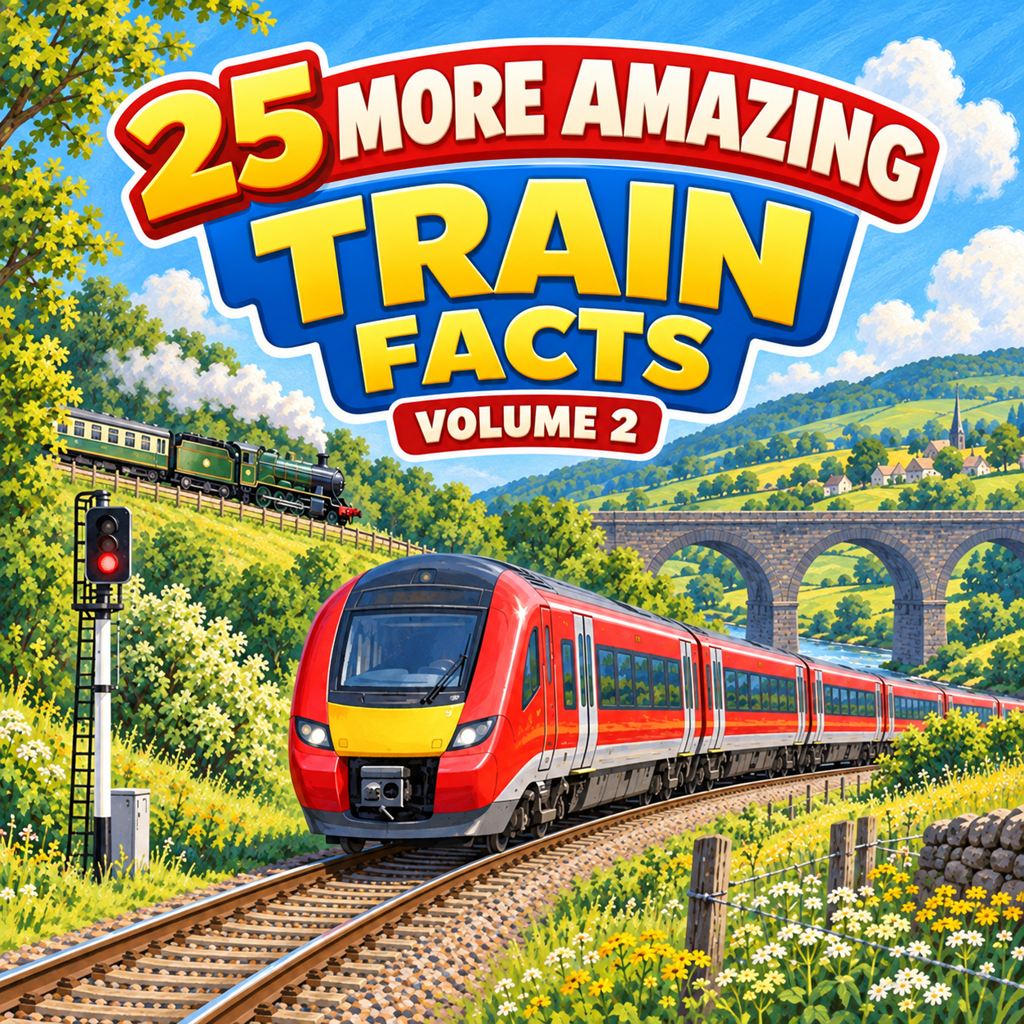
25 More Amazing Train Facts
Volume 2: tracks, signals and the trains that do big jobs
Listen
Listen to the story
Read
Read the story
Welcome to Read Listen Draw! This is Twenty-Five More Amazing Train Facts, Volume Two. Let’s discover how railways work. All aboard!
1. Train tracks have two steel rails. These strong, smooth strips guide the wheels along the railway.
2. Sleepers lie across the track beneath the rails. They support the rails and help keep them in position.
3. The crushed stones beneath many tracks are called ballast. They help support the sleepers and hold the track steady.
4. Inside a steam locomotive, a fire heats water in a boiler. The water becomes steam that powers the engine.
5. Steam pushes pistons backwards and forwards. Connecting rods carry that movement to the driving wheels, making them turn.
6. Many steam locomotives pull a special vehicle called a tender. It carries water and fuel for the journey.
7. A diesel-electric locomotive makes its own electricity. Its diesel engine drives an alternator, which supplies electric motors that turn the wheels.
8. Some electric trains collect power from a third rail beside the running rails. Sliding contact shoes connect the train to it.
9. Some electric trains can return electricity to the railway power supply while slowing down. This is called regenerative braking.
10. A boxcar is an enclosed freight wagon. Its roof and walls protect cargo from the weather.
11. Covered hopper wagons carry loose loads such as grain. Sloping floors help the load flow out underneath.
12. Cylindrical tank wagons carry liquids. Some transport water, while others carry ingredients such as thick, sweet molasses.
13. Refrigerated boxcars control the temperature inside. They help keep fruit and vegetables fresh during their railway journey.
14. Railway signals tell drivers whether they may move ahead. They help trains travel safely along the railway.
15. Points are movable sections of track. They guide train wheels from one track onto another at a junction.
16. Track circuits use electricity to help detect whether a section of railway is occupied. This information helps the signalling system control train movements.
17. A machine called a tamper packs ballast beneath the sleepers. It helps workers put the track in the right position.
18. Rail-grinding machines smooth the surface of rails. Looking after the rail surface helps give trains a smoother ride.
19. Wet, crushed leaves can make rails slippery. Special cleaning trains use powerful water jets to wash the leaf coating away.
20. Freight containers can travel by ship, train and lorry. The whole container transfers between them, without unpacking all the goods inside.
21. Special wagons called autoracks carry cars and other vehicles. Their decks make room for vehicles at more than one level.
22. Some container wagons have a low space called a well. On suitable routes, they can carry two containers stacked together.
23. Some freight trains have extra locomotives in the middle or at the back. These can be controlled remotely from the leading locomotive.
24. A railway turntable is a rotating platform. It can turn a locomotive so that it faces a different direction.
25. A funicular railway pulls its carriages along rails using a cable. This makes it useful for climbing a steep hillside.
Download
Download the story pack
📘
🖼️

Share this story pack
More like this
Related story packs
25 Facts About Castles
View story pack
25 Interesting Facts About Ancient Egypt
View story pack