
🎨
Audio Facts
Educational
Kids
Non Fiction
US region
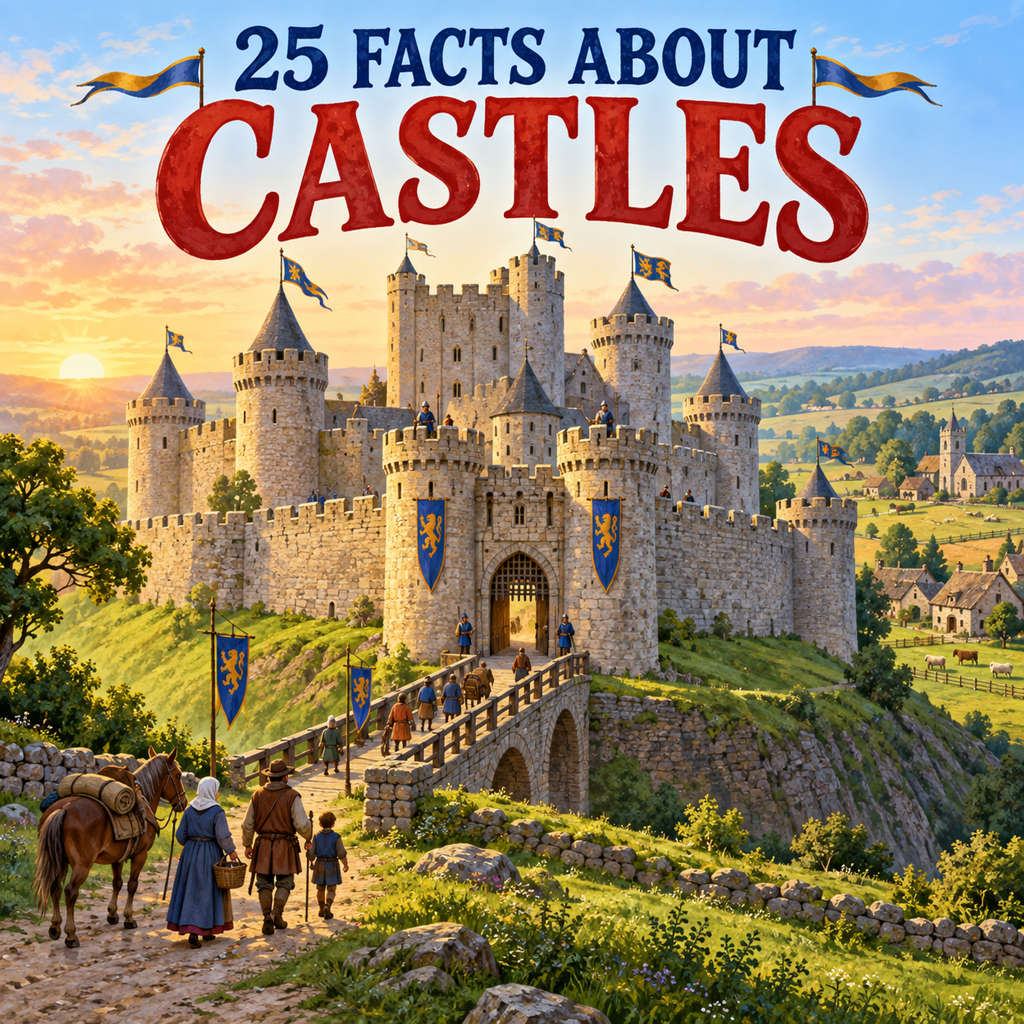
25 Facts About Castles
Explore mighty walls, secretive gatehouses and everyday life inside medieval strongholds
Listen
Listen to the story
Read
Read the story
Welcome to Read Listen Draw! Raise the drawbridge for Twenty-Five Facts About Castles.
1. A medieval castle was both a strongly defended building and a home for a powerful ruler or noble family.
2. Castles also displayed wealth and authority, so their appearance mattered as much as their defences.
3. Builders often chose strategic places, such as hills, river crossings, harbours and important roads, where people and movement could be watched.
4. Many early castles in England and Wales were built from earth and timber because those materials could be gathered and shaped quickly.
5. In a motte-and-bailey castle, the motte was a steep mound topped by a tower or strong enclosure.
6. The bailey was a defended courtyard containing useful buildings such as a hall, stables, workshops and stores.
7. Wealthy castle owners gradually replaced many timber defences with stone, which resisted fire and weather better but took far longer to build.
8. A keep, also called a great tower, was a castle’s main strongpoint and could also contain impressive rooms.
9. The high stone wall enclosing a courtyard was called a curtain wall. Masons made some walls several metres thick.
10. The main entrance was often the castle’s weakest point, so later gatehouses became powerful mini-fortresses with towers of their own.
11. A portcullis was a heavy lattice gate that slid vertically in grooves and could close the entrance passage.
12. Gatehouses could also have thick doors, arrow loops and openings in the ceiling through which defenders could attack intruders below.
13. A moat was a broad defensive ditch, and it did not always contain water.
14. Battlements had raised sections called merlons for shelter and open gaps called crenels for looking or shooting through.
15. Towers that projected beyond a wall gave defenders a wider view along its outside face.
16. Concentric castles had two or more rings of walls, forcing attackers to overcome one defended line after another.
17. Castles were busy communities, not empty stone shells. Families, guards, cooks, craftspeople, clerks and many servants could live or work inside.
18. The great hall was the social heart of many castles, used for meals, meetings, ceremonies and entertainment.
19. Castle kitchens could be hot and noisy, with large hearths, roasting spits, ovens and cauldrons preparing food for a large household.
20. A reliable well or stored water was vital, especially when a castle was surrounded during a siege.
21. Many castles had chapels, fireplaces and private chambers, while colourful plaster, paint and woven hangings made important rooms brighter and warmer.
22. Castle toilets were called latrines or garderobes. Waste often dropped through a chute into a pit, ditch or outside the wall.
23. During a siege, attackers might use stone-throwing machines, ladders, siege towers, battering rams or tunnels dug beneath walls.
24. Cannon became more important in the later Middle Ages, leading builders to add gunports and rethink tall castle defences.
25. Today, archaeologists, historians and conservators study and protect surviving castles and ruins, helping their stories last. Which castle fact will you draw?
Download
Download the story pack
📘
🖼️

Share this story pack
More like this
Related story packs
25 Interesting Facts About Ancient Egypt
View story pack
25 Amazing Dinosaur Facts
View story pack