🎨
Printable coloring pages
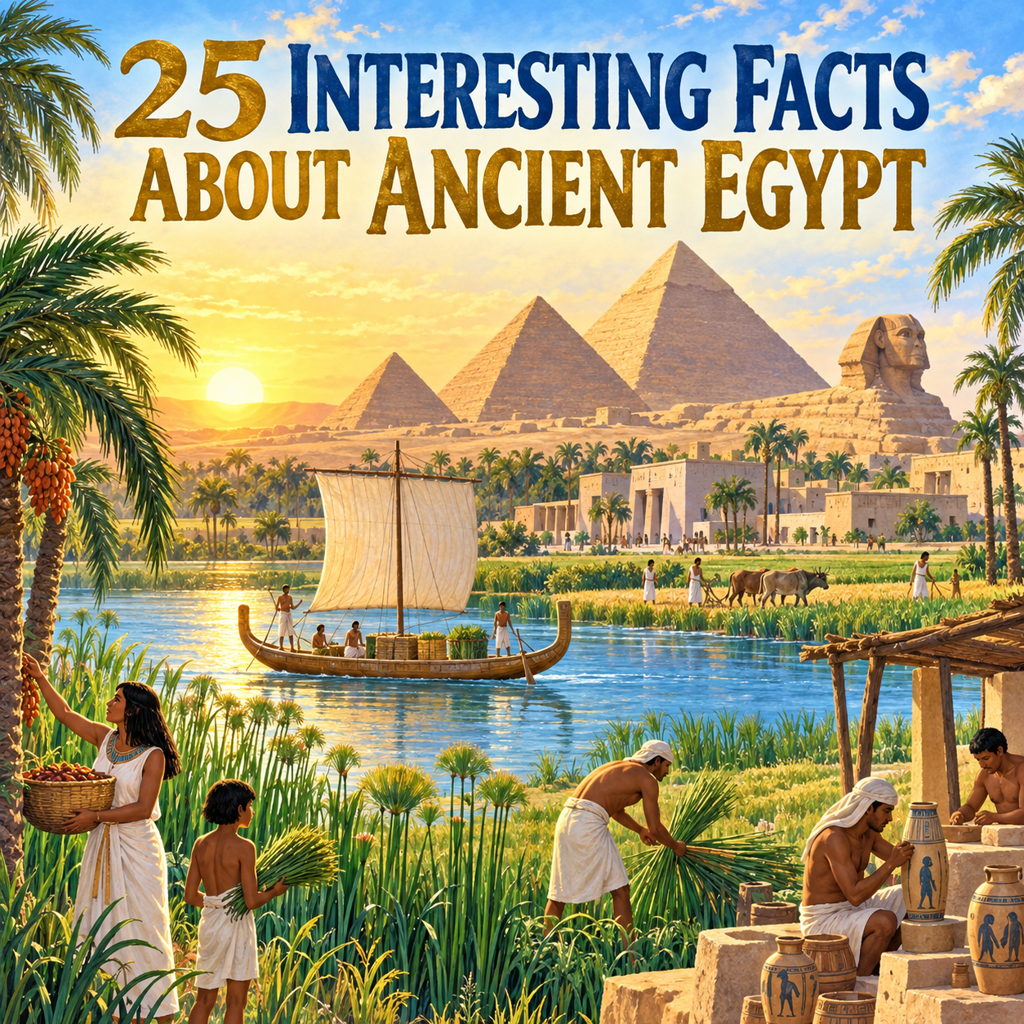
25 Interesting Facts About Ancient Egypt Coloring Pages (A4)
Download printableJourney along the Nile to discover pharaohs, hieroglyphs, pyramids and everyday Egyptian life
Listen
Read
Welcome to Read Listen Draw! Sail down the Nile for Twenty-Five Interesting Facts About Ancient Egypt.
1. Ancient Egyptian civilisation lasted more than three thousand years, from a united kingdom around 3100 B C to Roman rule in 30 B C.
2. Life depended on the Nile for water, food, transport and fertile land.
3. Vast deserts bordered the narrow green valley, providing stone, minerals and natural boundaries.
4. The Nile’s annual flood once spread water and rich silt across fields, helping farmers grow crops.
5. Egyptians divided their agricultural year into three seasons connected with flooding, growing and harvesting.
6. Papyrus reeds became boats, baskets, rope and a writing material, while Nile mud was shaped into bricks for houses. The river was also the easiest highway for moving people and heavy goods.
7. A pharaoh was Egypt’s ruler and was expected to protect order, honour the gods and govern the land.
8. Running the kingdom required officials, tax collectors and trained scribes who recorded harvests, workers and supplies.
9. Although society was unequal, Egyptian women could own and inherit property, make contracts and bring cases to court in their own names.
10. Egyptian hieroglyphs were used for thousands of years on monuments, tombs and many objects.
11. The signs did more than show pictures: they could represent whole words, sounds or clues that helped explain meaning.
12. Scribes also used faster, more flowing scripts for letters, accounts and everyday records. They wrote with reed pens and black and red ink on materials including papyrus, pottery pieces, wood and stone.
13. King Djoser’s Step Pyramid was Egypt’s first great stone pyramid.
14. Giza’s three main pyramids were royal tombs for Old Kingdom kings Khufu, Khafre and Menkaure.
15. The Great Pyramid once had a smooth outer layer of pale limestone.
16. Archaeology shows organized Egyptian crews built pyramids with skilled workers, rotating labourers, sledges, ropes and ramps.
17. Most homes were built from sun-dried mud brick, which suited the hot, dry climate better than expensive stone.
18. Flax was spun and woven into linen, the light fabric used for much Egyptian clothing.
19. Bread and grain-based beer were everyday foods, joined by vegetables, dates, fish and other foods when available.
20. Egyptians enjoyed music, toys and board games. Senet was played for centuries, though its complete rules have not survived.
21. Ancient Egyptians honoured many gods and goddesses connected with forces such as the sun, the Nile, protection, healing and the afterlife.
22. Mummification was meant to preserve a body. Embalmers dried it with a natural salt called natron, treated it with oils and wrapped it in linen.
23. Mummification could be costly, so people received different kinds of burial. Some animals, including cats, birds and crocodiles, were also mummified for religious reasons.
24. The Egyptian civil calendar had twelve months of thirty days, plus five extra days, making a year of three hundred and sixty-five days.
25. The Rosetta Stone carries one decree in hieroglyphic, Demotic and ancient Greek scripts. Comparing them helped scholars unlock the sounds and meanings of hieroglyphs. Today, Egyptian and international archaeologists combine inscriptions, objects, buildings and scientific tests to keep learning. Which fact will you draw?
Download
25 Interesting Facts About Ancient Egypt Coloring Pages (A4)
Download printableMore like this