🎨
Audio Facts
Educational
Kids
Non Fiction
US region
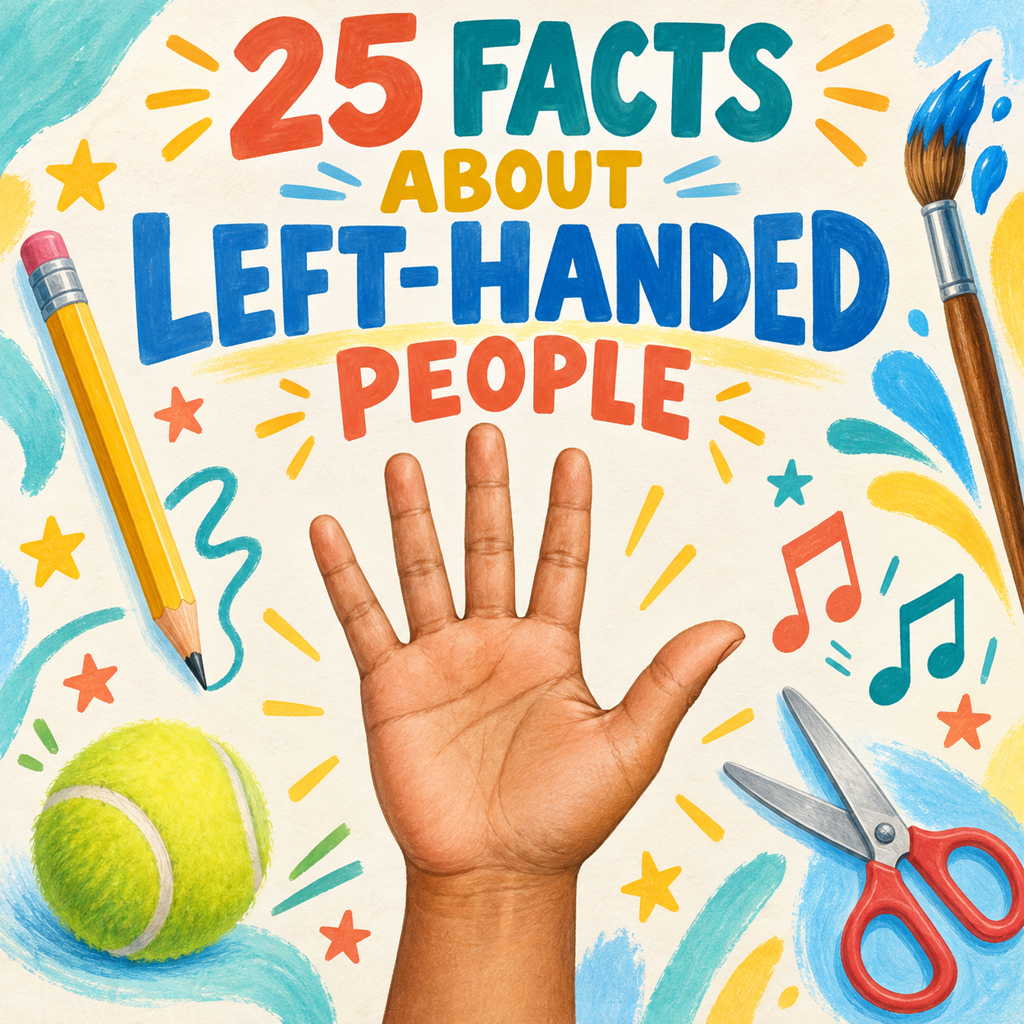
25 Facts About Left-Handed People
Discover how handedness develops, how the brain works and why every natural hand choice belongs
Listen
Listen to the story
Read
Read the story
Welcome to Read Listen Draw! Let’s discover Twenty-Five Facts About Left-Handed People.
1. Handedness is the hand a person usually prefers for skilled activities such as writing or throwing.
2. A hand preference is not an unbreakable rule. Many people use the other hand for some jobs.
3. Someone who prefers different hands for different tasks is called mixed-handed, while ambidextrous means similarly skilful with either hand.
4. A huge review of studies estimated that about ten point six percent of people are left-handed—roughly one person in ten.
5. The number changes a little depending on how researchers measure handedness and which activities they ask about.
6. Culture matters too, because people in some places and times were discouraged from saying they were left-handed.
7. Hand preference begins developing before birth; some babies already favour one thumb when sucking in the womb.
8. Left-handedness can run in families, but parents do not simply pass it on like eye colour.
9. There is no single left-handed gene. Many genes, together with early development and environment, help shape handedness.
10. Twins are a little more likely than single-born people to have an uncommon hand preference.
11. The brain has two connected halves called hemispheres, and both work together during everyday activities.
12. Most left-handed people still use the left hemisphere more for language, just as most right-handed people do.
13. Being left-handed does not mean someone is completely right-brained.
14. It also does not automatically make a person more creative, clever or artistic—those abilities use networks across the brain.
15. Many everyday objects were designed for the right-handed majority, including some scissors, can openers and school desks.
16. Left-handed scissors reverse the blades and often shape the handles differently, helping the user see the cutting line and make a clean cut.
17. Some tools are reversible or designed for either hand, so many people can use the same object comfortably.
18. Left-handed writers may turn or tilt their paper to find a comfortable position.
19. Wet ink can smudge when a writing hand passes over fresh words, so pencils, quick-drying pens and a good page angle can help.
20. In the past, some left-handed children were forced to switch hands at school, but choosing the comfortable natural hand is now widely accepted.
21. Left-oriented players appear more often than expected in some fast, face-to-face sports, such as tennis, fencing and baseball.
22. One possible advantage is surprise: players practise against right-oriented opponents more often, so a left-oriented opponent may feel unfamiliar.
23. That does not mean every left-hander is better at sport. Practice, coaching and enjoyment matter far more. Many activities also give both hands different jobs.
24. International Left Handers Day is marked on the thirteenth of August to celebrate left-handers and draw attention to everyday design.
25. Left-handed people are as varied as everyone else. Handedness does not decide a person’s personality, talents or future. A thoughtful classroom offers space and tools for different hand choices. Which fact will you draw?
Download
Download the story pack
📘
🖼️

Share this story pack
More like this
Related story packs

25 Facts About Castles
View story pack
25 Interesting Facts About Ancient Egypt
View story pack